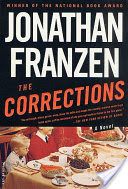
 The Corrections has been sitting on our shelf for years. Two people in my family read it and told me I would not like it so I expected it to sit there, unread by me, for many more years.
Then Erika chose to have us read The Corrections for our December/January book. I was not entirely pleased because I assumed, based on what family members told me, I’d not like it. It seemed like a long dull book about a family that I didn’t want to know anything about, despite the fact that the author may be a distant relative of Dean and, therefore, the kids.
I finished The Corrections on Saturday morning and rated it 3 stars on Goodreads from my Kindle (yes, I bought the book on Kindle — and Audible — because I could not find the book and we were in the middle of a basement remodel and I didn’t want to sift through the dozens of boxes of books). Soon after that I changed the rating to 4 and wrote a short review on Goodreads and responded to an online friend about her 1 star rating.
Last night I thought more about the book and discovered that I might like it enough to rate it 5 stars. The book was compelling enough to make me want to read it whenever I picked it up. The characters were very well fleshed out, although they all had many flaws. The story, though very depressing and disturbing, was well thought out and the book, was very well written.
To me, the most disturbing thing about the book is the fact that the family could, possibly, be any family. My family, my husband’s family, your family. Franzen, for the most part, focused on the negative traits of each character and accentuated their really bad decisions. While I didn’t want to identify with any of the characters, I did find myself giving most of my sympathy to Enid and Gary.
The Corrections made me think of the photographer Diane Arbus’ work. I remember looking looking at the photographs in her An Aperture Monograph collection and thinking that she could have photographed many of us in the same settings, with the same lens with the same film settings and we would have looked not much different from the people in the collection. That’s how I felt about how Franzen portrayed his characters and I wondered how Anne Tyler might have approached the Lambert clan — definitely more upbeat and more quirky than disturbing.
I’ve seen reviews calling the novel “Word vomit” and others complaining that they didn’t like the book because they could not sympathize with any of the characters. I disagree with both criticisms. I did sympathize with the characters, except perhaps with Caroline, Gary’s wife — but she was the least fleshed-out character in the book.
I am not a therapist or a psychologist, so I cannot speak to the depression that many of the characters seemed to have been plagued with. I got angry at the fact that everyone in the book made really awful decisions though — which may have been a result of the depression?
My biggest criticism is the ending. The ending was too happy for such a depressing book. Everyone seemed to have finally learned from their mistakes all at the same time which doesn’t seem real.
I did like the many references to Narnia — except naming the drug Aslan. I’ll have to think more on the relationship between the book and the Chronicles of Narnia. Maybe there is no relationship except that the author liked the series as a kid.
 Oh dear me God. I am so glad I have finally finished this book. I would have stopped, but didn’t want to give it away (like I had to with The Bronte Myth).


