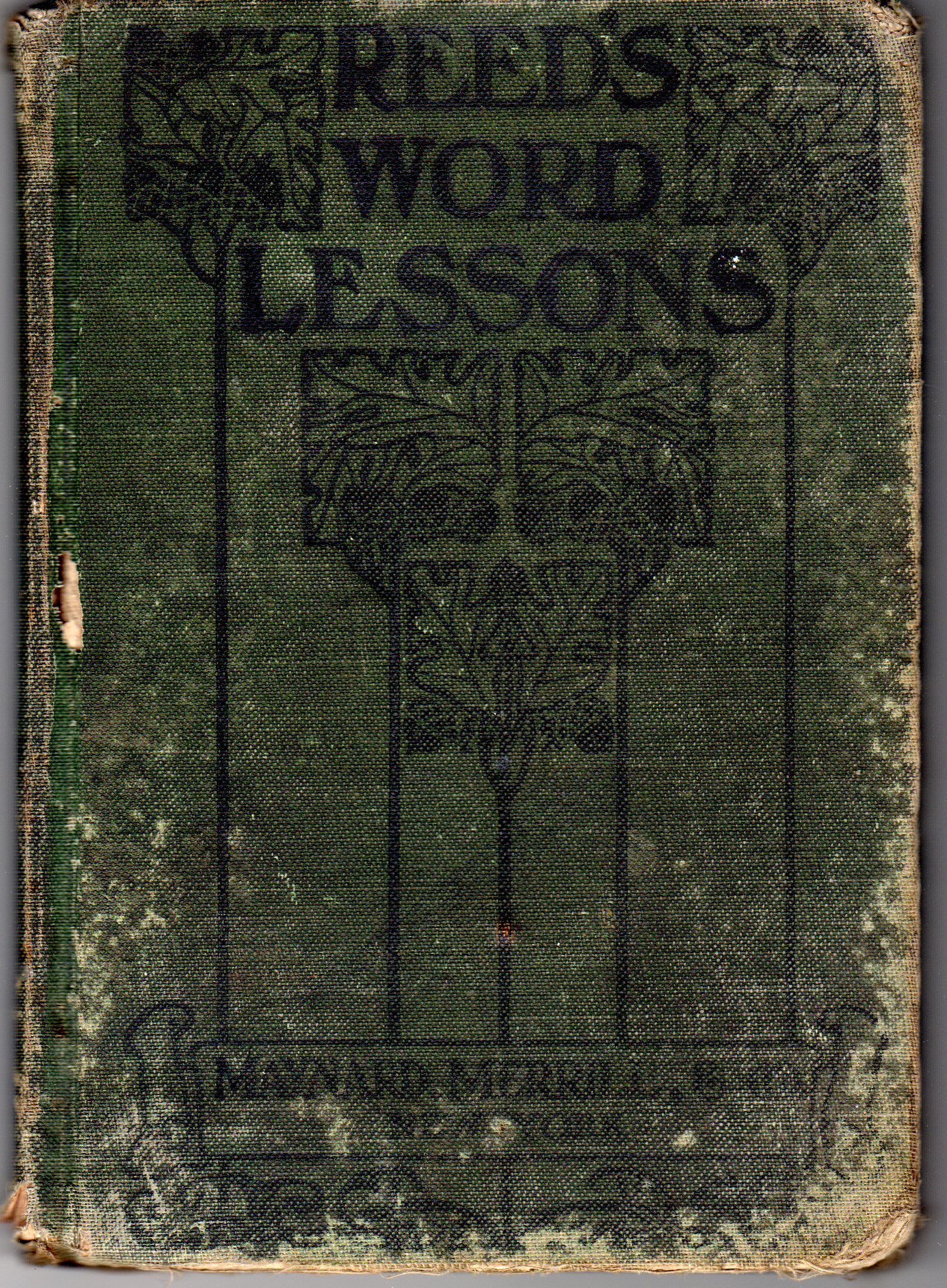
On my desk sits a 1906 beat-up copy of Reed’s Word Lessons by Alonzo Reed, A.M. The front endpapers are covered in childish writing: numerals 1-9 and the initials H. H. in small and large writing. The end endpapers have more writing: the number 15 in three places, Hyman Hernw, the name Patty and, in much nicer handwriting the words confectionary, confederacy, corb, coterie, dau, and daguerriolyn (which doesn’t seem to be a word). On a page that may have been reserved for notes is the name, Hyman Herron. Hyman also wrote his name on the edge of the book, across the pages.
The book itself is a spelling book for “the higher primary, intermediate, and grammar grades”. It contains 289 lessons starting with the “long a as in hate” and ending with prefixes and suffixes.
I don’t know when Hyman used this book. Perhaps when he was 15? I don’t know how this book came to be sitting on my desk. But below are some clues as to who Hyman Herron was.
Hyman was born in New York City to German (Prussian) immigrants, Issac and Fannie Herron on either December 25th or 26th in either 1895, 1896 or 1897, depending on what source you believe. His sister, Esther, was born in New York when Hyman was 2. By 1900 the family had moved to Elgin, Illinois. They lived, along with an Irish family, at 58 State Street, Elgin, Illinois. In 1910 they lived at 115 West Chicago Street in Elgin, which seems to be the Beckwith Building, built in 1888, according to Google Maps. Hyman’s father’s occupation is listed as “Fruit store” in the 1900 Census and Confectionary in the 1910 Census. Issac died October 23, 1910.
In 1917, Hyman registered for the draft. He was 21 and lived at 411 Prospect Street in Elgin and worked as a chauffeur for W. A. Kerbru (?) in Elgin, Illinois.
Hyman lived as a roomer at 310 Spring St. in Elgin, Illinois in 1930. The homeowners were George H. and Addie E. Rutledge. Dr. George H. Howell, a dentist, was also a roomer at this residence. It is possible Hyman paid $18 for rent. The home was worth $10,000 according to this Census report. His listed occupation is “Shipping Clerk” at a thread factory, which later information suggests was Collingbourne Mills.
In 1940, Hyman was still a single at 43, living at the Kelly Hotel in Elgin, Illinois. and was still working for, probably, Collingbourne Mills.
In 1942, Hyman again registered for the draft. He was 45, living at the Kelly Hotel and still working at Collingbourne Mills. Harold Rule, also of the Kelly Hotel, is listed as someone who would always know Hyman’s address. Hyman’s telephone number was 6086.
Hyman’s mother, Fannie, died March 23, 1962, and is buried in the Elgin State Hospital Cemetery. Her gravestone also contains the numbers 771. Interestingly Fannie is listed as Lena in the 1900 census, but Fannie in 1910. It could be two different women, but the age seems the same.
Hyman’s grave marker indicates he died on June 22, 1975, was buried in Mount Hope Cemetery, in Elgin, Illinois.
This leaves me with more questions — how did Issac die? Why was Fannie at the Elgin State Hospital? How long was she there? Was she also Lena or was that another wife? What happened to Esther? Did she marry? And how did this book end up on my desk?
The only connection, besides Elgin, is Collingbourne Mills. My grandfather worked there as a traveling salesman when he met my grandmother. Perhaps he knew Hyman Herron from work. Hyman was about 12 or 13 years older than my grandfather. My grandfather probably worked at Collingbourne Mills in the early 1930s. Did he give my grandfather the book? Or perhaps there was no connection and this book ended up at my mom’s house with a bunch of other stuff from an antique store.
At least I’ve given Hyman and his mother (and sister and father) some thought today.