Alexandria Packet November 13, 1986
by Maria Kavanagh
Special to the Packet
Frances Lide had been in Washington only a few hours when she lost practically everything she owned.
This was 1934 when the Depression blanketed the country and losing everything meant just that.
“I had come to Washington from South Carolina to get a job with one of the New Deal agencies until I could find a job as a journalist. Jobs on newspapers, as most other jobs, were incredibly difficult to come by.”
She tells of her introduction to Washington with a wry detachment:
“A friend had met me at the railroad station with a borrowed car. On the way to my hotel we stopped at his boarding house where I had been invited for dinner. Afterwards, as we were leaving for the hotel we discovered that my large suitcase with all my winter clothes — it was December — and practically everything else I owned, had been stolen. Fortunately, I had carried in with me a small bag with my letters of introduction and a few toilet articles.”
Her letter to the Fourth Assistant Postmaster General got her a job as a clerk-typist in the Treasury Department’s Bureau of Public Works within a few days. But typing up labels wasn’t exactly what she had in mind when she came to Washington. Determined to write, she constantly made the rounds of every newspaper, wire service and agency which might use a journalist. Meanwhile, along with her government job, she wrote regular columns from Washington for North and South Carolina papers.
After a year of dogged persistence, she was hired as the first woman in the news room at the Washington Star.
“I was hired to cover Eleanor Roosevelt’s weekly press conferences. Mrs. Roosevelt insisted upon being covered only by women. Most women journalists at that time were society editors and society columnists and had had no experience.”

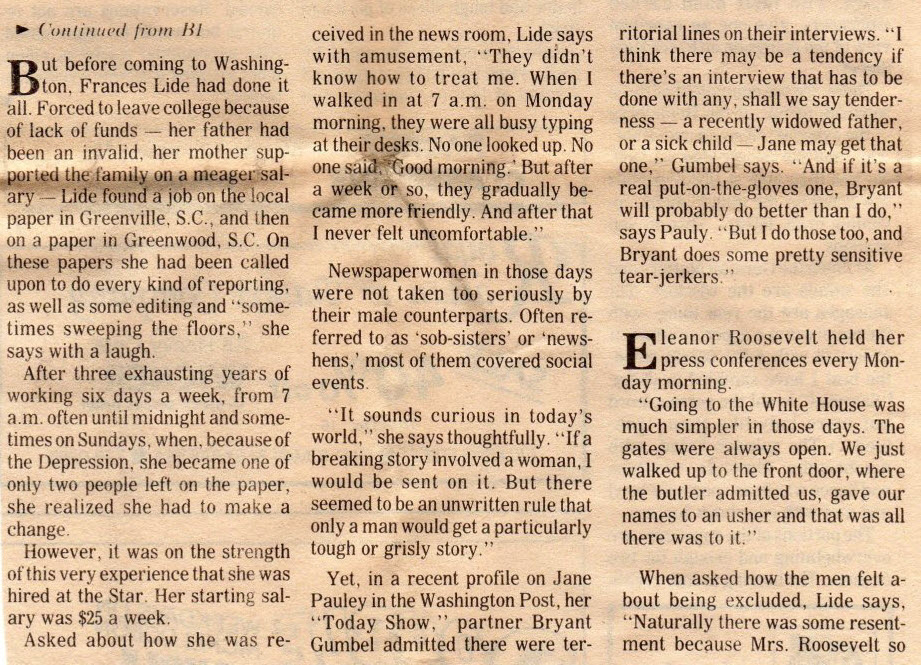
But before coming to Washington, Frances Lide had done it all. Forced to leave college because of lack of funds — her father had been an invalid, her mother supported the family on a meager salary — Lide found a job on the local paper in Greenville, S.C. On these papers she had been called upon to do every kind of reporting, as well as some editing and “sometimes sweeping the floors.” she says with a laugh.
After three exhausting years of working six days a week, from 7 a.m often until midnight and sometimes on Sundays, when, because of the Depression, she became one of only two people left on the paper, she realized she had to make a change.
However, it was on the strength of this very experience that she was hired at the Star. Her starting salary was $25 a week.
Asked about how she was received in the news room, Lide says with amusement “They didn’t know how to treat me. When I walked in at 7 a.m. on Monday morning, they were all busy typing at their desks. No one looked up. No one said ‘Good Morning.’ But after a week or so they gradually became more friendly. And after that I never felt uncomfortable.

Newspaper women in those days were not taken too seriously by their male counterparts. Often referred to as ‘sob-sisters’ or ‘news-hens,’ most of them covered social events.
“It sounds curious in today’s world,” she says thoughtfully. “If a breaking story involved a woman, I would be sent on it. But there seemed to be an unwritten rule that only a man could get a particularly tough or grisly story.”
Yet, in a recent profile on Jane Pauley in the Washington Post, her “Today Show” partner, Bryant Gumbel admitted there were territorial lines on their interviews. “I think there may be a tendency if there’s an interview that has to be done with any, shall we say tenderness — a recently widowed father, or a sick child — Jane may get that one, Gumbel says. “And if it’s a real put-on-the-gloves one, Bryant will probably do better than I do,” says Pauley. “But I do those too, and Bryant does some pretty sensitive tear-jerkers.”
Eleanor Roosevelt held her press conference every Monday morning.
“Going to the White House was much simpler in those days. The gates were always open. We just walked up to the front door where the butler admitted us, gave our names to an usher and that was all there was to it.”
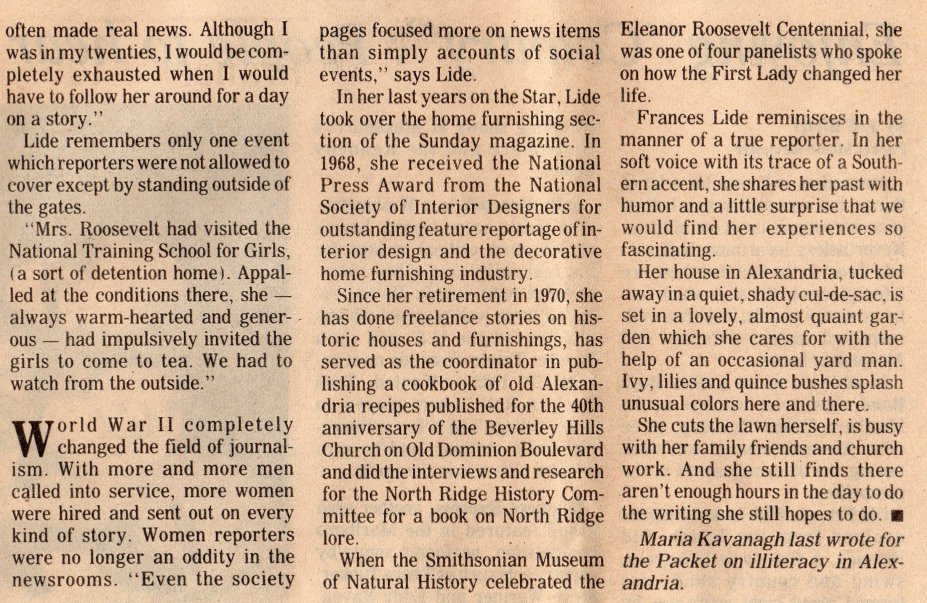
When asked how the men felt about being excluded, Lide says, “Naturally there was some resentment because Mrs. Roosevelt so often made real news. Although I was in my twenties, I would be completely exhausted when I would have to follow her around for a day on a story.”
Lide remembers only one event which reporters were not allowed to cover except by standing outside the gates.
“Mrs Roosevelt had visited the National Training School for Girls (a sort of detention home). Appalled at the conditions there, she — always warm-hearted and generous — had impulsively invited the girls to come to tea. We had to watch from the outside.”
World War II completely changed the field of journalism. With more and more men called into service, more women were hired and sent out on every kind of story. Women reporters were no longer an oddity in the newsrooms. “Even the society pages focused more on news items than simply accounts of social events,” says Lide.
In her last years on the Star, Lide took over the home furnishing section of the Sunday Magazine. In 1968 she received the National Press Award from the National Society of Interior Designers for outstanding feature reporting of interior design and the decorative home furnishing industry.
Since her retirement in 1970, she has done freelance stories on historic houses and furnishings, has served as the coordinator in publishing a cookbook of old Alexandria recopies for the 40th anniversary of the Beverly Hills Church on Old Dominion Boulevard and did the interviews and research for the North Ridge History Committee for a book on North Ridge lore.
When the Smithsonian Museum of Natural History celebrated the Eleanor Roosevelt Centennial, she was one of the four panelists who spoke on how the First Lady changed her life.
Frances Lide reminisces in the manner of a true reporter. In her soft voice with its trace of a Southern accent, she shares her past with humor and a little surprise that we would find her experiences fascinating.
Her house in Alexandria, tucked away in a quiet, shady cul-de-sac is set in a lovely, almost quaint garden which she cares for with the help of an occasional yard man. Ivy, lilies and quince bushes splash unusual colors here and there.
She cuts the lawn herself, is busy with her family, friends and church work. And she still finds there aren’t enough hours in the day to do the writing she hopes to do.
Maria Kavanaugh last wrote for the Packet on illiteracy in Alexandria.