Monthly Archives: August 2011

Too many screens

As an afterthought to my last post I began counting the screens in our house then I lost track because I was distracted by one of them. I seriously think this could make an interesting short story.

We have 3 screens in the basement — a television and two monitors for a desktop.

On the main floor we usually have 8 screens — a television in the back room, Clare and Dean’s smart phones, my Nook and 4 laptops.

On the third floor we currently have 2 screens — a television and Andrew’s laptop.

Finally in the attic/office we have 4 screens, all at my work area. My work laptop is attached to an external screen so I can have more room to work. I also have a smartphone and a 7 inch tv connected to a Roku on my desk for distraction while I work on repetitive tagging of PDF files.

So, if I added correctly we have 17 screens in the house right now (not counting my old smartphone in the drawer and various digital cameras around the house). This number may be reduced by 4 in the near future, but why would a family of four need 17 screens? Better yet, why would two people (which we will be once the kids are at college) need 13 screens? I admit to using 3 at a time when I work sometimes — maybe 4 when I check my phone, but I think 6 each is a little much.

When the kids were younger we’d punish them by taking away “screen-time”*. I’m only now beginning to understand what a powerful punishment that was.

*we also established Sundays as “no screen days” — for kids only of course. Man were we mean!

What was going to be a brilliant cohesive post about hope turned into an incoherent ramble

I’ve written a lot about reading on this and other blogs. I write about it so much because I care about it so much and I mourn the death of my once voracious appetite for books. It’s not that I cannot get into a book now and then — it is more that I can easily put a book down and not pick it up for days, or even weeks. Even books I love.

A friend once said she envied my love for reading — something she never had. She said she read, but didn’t seem to get the same pleasure out of it that I did. I thought everyone loved to read, but were disciplined enough to not give into the habit.

As a child my mother once told me I “read too much”. I’m not sure if I took that as an insult or a compliment back then. Now I take it as a compliment, but I think she was chastising me for choosing books over people or other activities. When I read Lali’s post, B is for Book, I felt comforted knowing that other people were told to put their books down when they were young.

I think that, because of my 15 or so years of being in a bookgroup, reading books has become a chore. Like housework or homework. Like changing the kitty litter. Also my use of the Internet gets in the way of reading for pleasure — that’s a fact and that’s also something I’m going to be working on reducing. I’ve been watching more TV — films and on-demand cable programs that I got hooked on. That’s going to go too, especially since we’re planning on cutting back our cable to basic to help reduce costs.

Last week, I followed a link on Facebook to an article in The Chronicle of Higher Education by Alan Jacobs, professor of English at Wheaton College in Wheaton, Illinois (although I didn’t realize that until a friend of mine from Illinois pointed it out). The article proposes that only a small fraction of people are “extreme readers”, readers who genuinely love reading and read with “sustained, deep, appreciative attention”. He further theorizes that such readers are not made, but born. While I don’t agree with either statement, I did like this article because it gave me some hope that perhaps I’d be able to get back that love of reading that I once had.

My favorite quote in the article mentioned mentioned Narnia and Susan* Pevensie, my favorite character in the series, and completely illustrated my anguish:

“But then there are the people Nicholas Carr writes about in The Shallows: What the Internet Is Doing to Our Brains, and Carr himself: people who know what it is like to be lost in a book, who value that experience, but who have misplaced it—who can’t get back, as Lucy Pevensie for a time can’t get back to Narnia; what was an opening to another world is now the flat planked back of a wardrobe. They’re the ones who need help, and want it, and are prepared to receive it.”

I mistakenly thought that the book he mentioned by Nicholas Carr would have something to do with Narnia, so I immediately downloaded that onto my Nook. (which I really liked, but hoped it would give me ideas on how to learn to love to read again, but it didn’t.)

As I mentioned a few weeks ago, I’ve given up my book groups for a year — perhaps longer — to see if I can rekindle my love for reading. I’ve read a few books so far since my announcement — but two were obligatory reads — one because I got a free copy and promised to write a review on Amazon and the other because someone lent it to me. Nicholas Carr’s book was my first non-obligatory read in a while.

It seems that Jacobs has a book out on this very subject called The Pleasures of Reading in an Age of Distraction. In fact the article was an excerpt. Maybe that will be on my list of books to read soon.

*Rereading the quote I realize he mentions Lucy, not Susan. I assumed it was Susan because she is shut out of Narnia after Prince Caspian — a fate I still don’t forgive C. S. Lewis for.

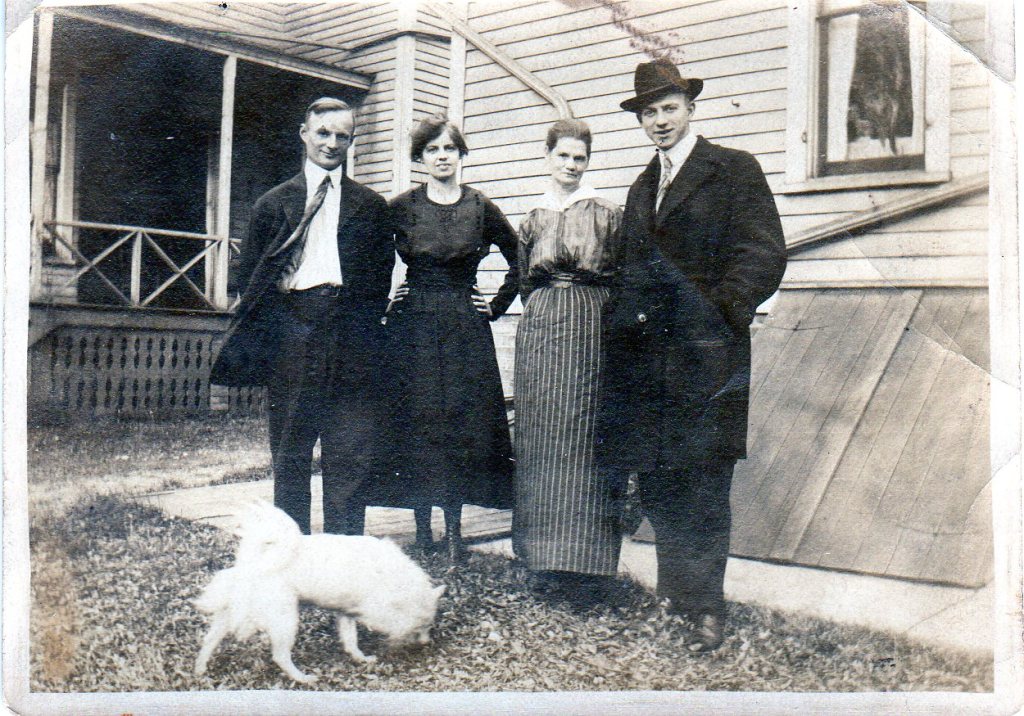
My grandfather’s elusive father

I’ve known my maternal grandfather’s lineage from his mother’s side for a very long time. It made such a huge impact on me that I vowed to be married in the church that our ancestors built near Elgin and loved to tell people that the creek that flows on the West side of Elgin is named after the Tyler branch of my family.

I knew very little about my grandfather’s father, however except that he divorced his wife and was out of the picture early in my grandfather’s life. Apparently, he knew his mother’s second husband, Frank Harris, as a father.

Yesterday, however, I discovered more than I’d ever hoped about that great grandfather’s family.

Albert Green

His name was Albert Green and was the son of Swedish immigrants. His father, Emil Green married Amanda Johnson on March 19, 1887, in Cook County, Illinois. His occupation is listed as a carpenter. He was 22 and she was 24. Emil and Amanda had two other children besides Albert. Their first child, a girl named Hildur was born on November 19, 1888, and they lived at 6005 May Street in the Englewood part of Chicago when she was born, according to her birth certificate. Albert was their second child, born on February 25, 1891. Their third child, Harold, was born April 2, 1898. Emil died of Typhoid fever on June 17, 1899, and is buried at Oakwood Cemetery. Amanda died in Elgin on August 8, 1934, and is buried at Bluff City Cemetery in Elgin.

Harold, Hildur, Amanda, Albert

Albert married Jessie May Tyler on May 5th, 1909. My grandfather, Walter Tyler Green was born January 31, 1910. And according to the census of 1910, both Albert and Jessie lived with her parents (and brother and his wife) at the house on Highland Avenue (615 West) in Elgin.

Albert died on October 19, 1921, in South Elgin, Illinois. The family story is that he was struck by a train on the railroad tracks in South Elgin, but the death record does not tell the cause of death. He was a roofer. He is buried at Bluff City Cemetery.

Jessie married Frank Harris, a German who arrived in the United States in 1900, by the 1930 census because he is listed as being the son-in-law of Jessie’s father with whom he, Jessie and my grandfather lived.

I cannot find a record of Jessie’s or Frank’s death, but according to John McCornack, Jessie died in 1949 and Frank died in 1958. According to family legend Jessie was struck by a car while crossing the street and Frank hanged himself out of grief over Jessie’s death. However, 9 years is a long time to grieve and then commit suicide. Something doesn’t seem right.