My mom had a soft spot for ugly dolls. She liked going to antique shops and occasionally purchased the ugliest doll there because she was afraid that doll would never be loved.
A few years ago she gave me two of these dolls “for Clare” but Clare really didn’t want them. I often have them sitting on the back of my office sofa staring at the back of my head while I work.
The first looks like she’s dressed up to go on a trip. Her clothes are elaborate, handmade for sure. She’s wearing pantaloons and a petticoat under a traveling skirt and coat. The undergarments are finished with lace and the skirt and coat are lined. I thought this was a very old doll, but I am now thinking it is not so old, maybe from the 1970s or later. The rear has a stitched name and probably company name: “Meg Jandolls.” What’s creepy about her is her expression. Eyes that bore right into you and a small, slightly askew mouth.
Meg the traveling doll
The other doll is, I think, much older. I call her the strict nanny. Her graying hair is in a messy bun, Her face is stern (or shyly smiling depending on the angle). She’s wearing a pink gingham dress over a petticoat. Over her dress is an apron. Barely visible in the photo below are her black (removable!) boots.Her hands snap together so she can hold a baby. The baby wears what looks like a baptismal gown and a pink knit shawl. I think both the nanny and the baby had bonnets, but they’ve been misplaced.
Strict Nanny Doll
The baby, now that I look at her without her bonnet reminds me a lot of young Karen from the BBC series, Outnumbered.
Karen
Doll
Okay, maybe not, but to be fair Karen’s hair often looked like the doll’s hair in the early episodes.
All three of these dolls will continue to sit in my office unless I decide to put them on the guest beds. I am pretty sure someone could write a Shirley Jackson-type short story about each of these dolls.
I’ve written elsewhere about My Book House Books. When I was in Elgin in February I brought the parents’ guide to the set back to Bethesda.
The first of the two guides is called “In Your Hands: A Parents’ Guidebook” and features such quotes as “The child who reads is the child who leads.” and “…..Today is one fleeting moment…..A miracle and unrepeatable.”
The first part of the book is full of guidance to parents on raising their children to become readers which will help them become solid citizens with not only an appreciation of literature but also a firm grasp of language skills and a good character to boot. The rest of the book continues the guidance in a more age-specific way from birth through age twelve. At the end are chapters on how to use the book for holidays or seasons of the year. At the end of the book is a “Character Building” index for different parts of “My Book House.”
Reading through this now, as dated as the photos and some of the guidance is, it does mention ideas that are still popular in current thinking about children and books such as “if your children see you enjoying books, they are more likely to enjoy reading”. Here’s what “In Your Hands” says about that:
Baby Reflects Your Attitude Toward Books
Children quickly sense your attitude and actions toward books as well as other things. You will find your child imitating the very things you do when handling a book.
Of course, most of the photos of a parent reading to their children are of women. There is one photo of a father and son, but they are standing outside and on a page with a poem titled “A Little Fellow that Follows Me.”
The second of the two guides is called “Your Child’s World: The Specific Approach to Daily Problems.” The first chapter, called “Some Ideas About the Home, the Family and Being a Parent” talks about how to make a creative home, how to foster security at home and why parents say “no.”
The rest of the book is packed full of scenarios that may occur in the home and tips to handle them as well as a discussion at the end.
For instance here’s one titled “What Would You do about Father’s Ill-timed Treats?”
What Would You do about Father’s Ill-timed Treats?
Evelyn, age six, and her brother, age four, rush up to greet their father upon his return from work and he usually has some candy treats for them. However, when they eat the candy this spoils their appetite for dinner.
If you were the parents of Evelyn and her brother, what would YOU do?
Make them promise to save the candy until after dinner,
Give the candy into Mother’s safekeeping until after dinner,
Take it away from them and gie them none the next day if they begin on it before dinner,
Let them have a little taste before dinner, saving the greater part until after the meal is over,
Insist that they eat a certain amount of dinner “no matter what.”
Have Father postpone giving them anything until after they have finished eating.
Discussion
This issue is a matter for parental unity. The most efficient and reasonable approach is (f). All of the others represent needless compromise which is difficult on all concerned. (a) would be an acceptable first step if it works, and it may. However, if it results in broken promise, such punishment as is involved in (c) is not good. (e) would probably create more problems and larger ones than the orignal. (d) would cerate a lot of fuss and even a “little taste” may take the edge off the children’s appetite. (b) is not quite fair to Mother since it puts her in the position of withholding, and in addition, the sight of the candy may make the dinner less attractive. Father should be able to hold off with his largesse and, who knows,may he not in the long run be assured that they are running to greet him for himself and not for the goodies?
I don’t think my mom read much of these books, but I might be wrong. I don’t remember he going through the Book House Books with me, but I do remember reading them on my own. Whatever the case, I am so grateful that she and Dad bought the books because I attribute my love of reading to them.
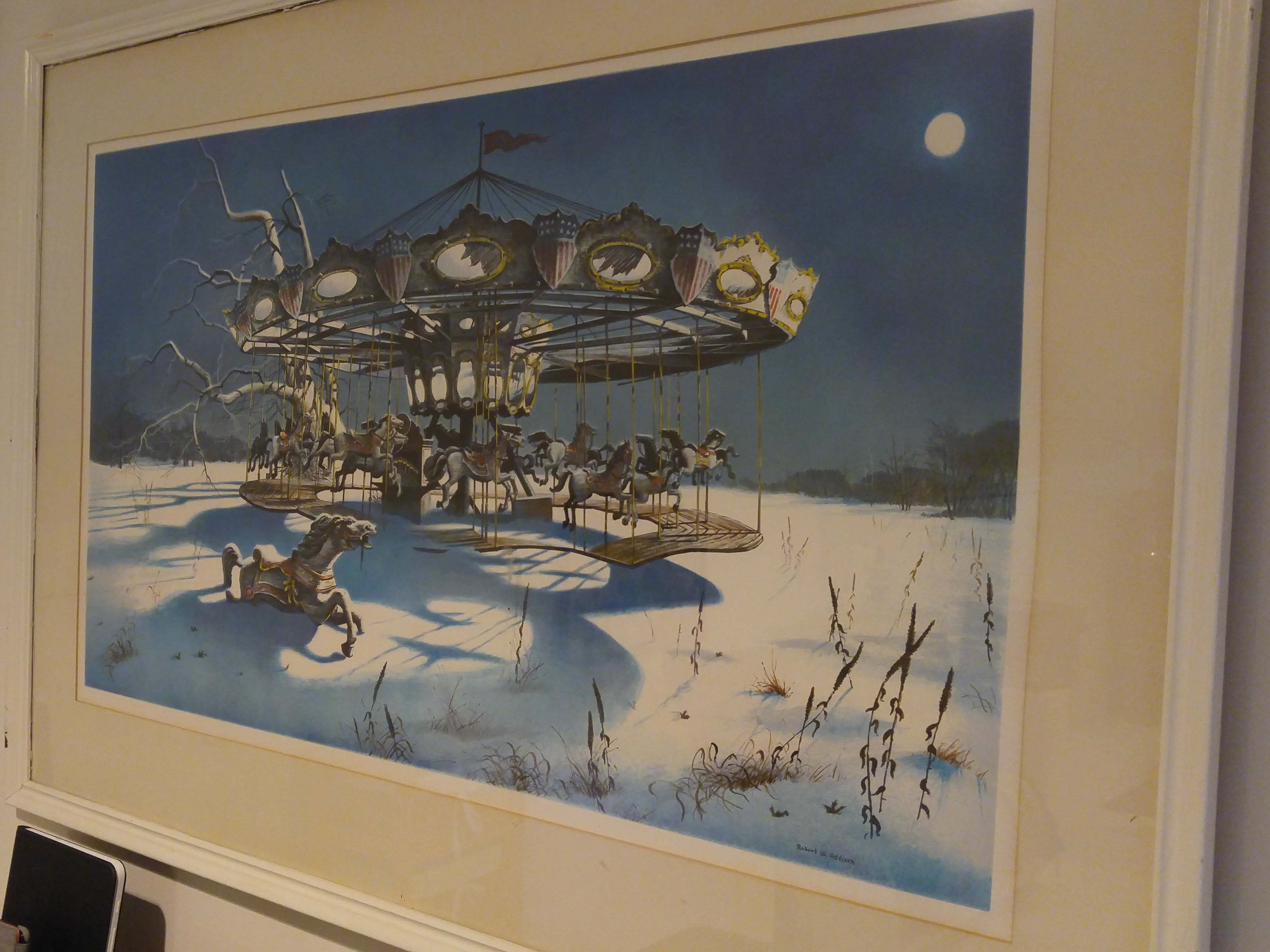
When? It was probably 1980 or 1981, it could have been later, but by then we were living in Pittsburgh. Where? It was probably Woodfield Mall in Schaumburg. I don’t remember the exact circumstances, but I do remember the emotion. I don’t even remember who I was with when I first saw it — maybe Mom and Aunt Ginny. All I really remember is walking past the window and seeing the painting and having a powerful feeling of sadness, but also a feeling of desire. I wanted to own the painting.
I must have talked to Dean who probably reluctantly agreed to visit the Merill Chase Gallery in the mall to see if he wanted to own it too. I do remember going into the gallery and telling a Merill Chase employee that we were interested in purchasing the painting in the window. The employee showed us a small room with a sofa or comfortable chairs and invited us to sit while she had the painting brought to us and placed on an easel. She left us alone for a few minutes while we talked about it. I explained why I liked it. I don’t recall Dean’s responses. I really wanted it. It was not too expensive, as I recall something we could afford, but not easily. It turned out that the painting was actually a serigraph and came with a certificate of authenticity.
We bought the serigraph and it hung in the living room of our Pittsburgh apartment. It must have hung in our Alexandria homes — in places where visitors could see it. For many years it hung above our bed in Bethesda. One night Clare and Andrew asked me the story of the painting. Since I didn’t know the actual story, I made one up. I don’t remember exactly what I said, but it had something to do with the merry-go-round being magical so the horses could still run on it but one horse wanted to run free and jumped off the carousel, only to freeze a few hundred feet away from the merry-go-round. No happy ending. I think it made the kids very sad.
Once I realized that the Internet knew everything, I looked up the artist, Robert Addison. I found a few things about him. His other work was often as depressing. The merry-go-round in my serigraph is featured in some of his other work. Its origin is based on seeing a bombed out merry-go-round when he was stationed in England during World War 2. The painting was completed in 1979. I think he did two versions of it because there is mention of “Moonlit Merry-go-Round, II” on the Internet. More recent searches have found that Dennis De Young from Styx used Moonlit Merry-go-Round on an album called One Hundred Days from Now.
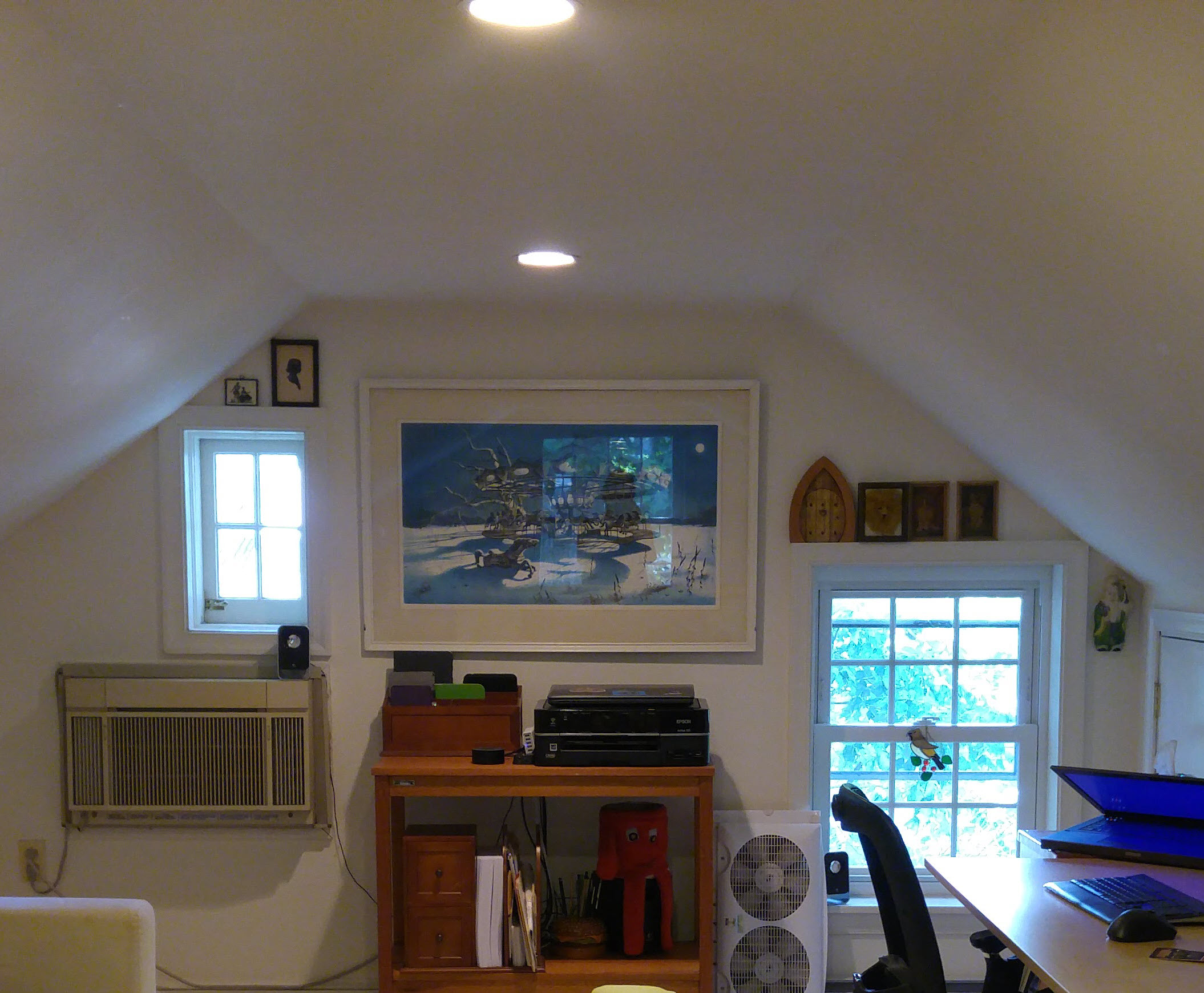
Once I established my attic office the painting was taken there. I think it makes Dean sad, and he doesn’t really like it — I don’t think he ever did. But I do, I still do. Only I ever see it now — or Dean when he comes to the attic. Very rarely do guests visit the attic so, the only actual piece of art (by an artist who is not a friend or family member) is hidden away for only a few sets of eyes. And that makes me sad.


 Clutch Cargo Lips