 In sixth grade my friend, Eugenia, introduced me to the genre of Gothic novel. I’d fill a grocery bag full of them at the library, take them home, devour them in a week, then return to the library the following Saturday, hungry for more.
By the time I discovered the Brontës, I’d read most of the contemporary Gothic novels at the library and decided to go to the source. I’d just returned from a visit to Bronte country and was embarrassed to admit that I’d never read any of their works. So my sophomore year in college I read Wuthering Heights in 15-minute increments before I began my homework each day.
I finally grew out of Gothic novels and moved on to other genres. But when I heard about The Thirteenth Tale, I had to buy it. I had no option. I had to read it.
The Thirteenth Tale sat on my bookshelf for months waiting to be read. It wasn’t quiet about it either. It whispered to me each time I passed. “Read me. Read me.” Because I had other things to read first, I was not able to abide by its request. Until last weekend…
“It’s my profession. I’m a storyteller,” Vida Winter explains when defending the numerous lies she’s previously told about her past.
Her real past, the truth, as told to Margaret Lea, proves to be the best story of them all, filled with characters so rich, so colorful they could have stepped out of novels written by the Brontë sisters, Wilkie Collins or George Elliot. Set in the same Yorkshire moors that inspired the Brontë sisters, Vida Winter’s life story reads like a real Gothic mystery.
When Margaret Lea, the daughter of an antiquarian bookstore owner, discovers she had a twin sister who died at their birth she understands her feelings of aloneness. She comforts herself with the unwanted books of her father’s bookshop – her only companions other than her protective father and distant mother. When the famous author, Vida Winter, approaches Margaret to write her biography, Margaret is not so sure, but visits Ms Winter in her Yorkshire home. As Vida Winter reveals her story to Margaret, both Margaret and the reader are immersed in an unforgettable tale spanning three generations.
Isabelle Angelfield was odd.
Isabelle Angelfield was born during a rainstorm.
It is impossible to know whether or not these facts are connected. But when, two and a half decades later, Isablle left home for the second time, people in the village looked back and remembered the endlessness of the rain on the day of her birth. Some remembered as if it was yesterday that the doctor was late, delayed by the floods caused by the river having burst its banks. Others recalled beyond the shadow of a doubt that the cord had been wrapped round the baby’s neck, almost strangling her before she could be born. Yes, it was a difficult birth, all right, for on the stroke of six, just as the baby was born, the doctor rang the bell, hadn’t the mother passed away, out of this world and into the next? So if the weather had been fine, and the doctor had been earlier and if the cord had not deprived the baby of oxygen, and if the mother had not died…
And if, and if, and if. Such thinking is pointless. Isabelle was as Isabelle was, and that is all there is to say about the matter.
If you are a fan of gothic novels, this book is a must. Even if you’ve never read a Gothic novel, you should still check this book out. It is a can’t-put-it down/stay-up-all-night kind of read.
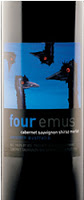 The other day I went to a cafe with a couple of friends. The wine is on wine racks and you can pick out your bottle, the staff will open it and you can drink it with dinner. None of us know a whole lot about wine – I know to avoid certain kinds and labels, but don’t really know what’s good or not. So Alison decided on a cab/shiraz/merlot blend from Australia – not because she liked the brand or the wine inside, but because she liked the look of the label (shown on the right). I was slightly concerned. The wine was fine though. Sometimes judging a book by its cover doesn’t work, but sometimes it does.
 Another time it worked out well was when I was shopping at Target. I don’t know what I was looking for, but a CD caught my eye. Normally I stick with musicians I know and like or were recommended to me. I’d been thinking a lot about my hometown in Illinois, so when I saw the title “Illinoise” in bright yellow letters I looked a little closer. The names of the songs were amusing and I felt like I needed a new CD anyway. So I bought it even though I’d never heard of the artist, Sufjan Stevens.
