Category Archives: Memories

Cindy/Cynthia

I met Cindy my first day of junior high. She sat at the same lunch table as I did that day. It didn’t take us long to start hanging out at each other’s houses — in fact, her father, who was a 6th grade teacher dropped her off at my house each morning and we’d walk to school together. Then each afternoon we’d walk back to my house and spend the afternoon together before her dad picked her up after work.

Cindy’s mom was a vegetarian. The only vegetarian I’d ever met. Her father wasn’t. They lived in the country in an arts and crafts style bungalow on 13 acres they called Walden Oaks. They had a potbelly stove in their living room and Cindy always smelled of woodsmoke. She had long, black curly hair, huge eyes and a large smile. We were inseparable in junior high.

We continued our friendship into high school, but in our junior year Cindy’s father decided to take a sabbatical the following year and spend it in Spain with Cindy and her mother.  That meant that Cindy would need to graduate a year early. She seemed to change that year. She spent more time with seniors and less time with me. Our friendship was strained as it was — the old saying, “familiarity breeds contempt” proved true in our case. I think we’d spent so much time together the first few years of knowing each other, that we got to know each other too much — almost like sisters, I suppose. I remember being jealous of her grades — I guess I thought I  was the smarter of the two of us and when she got better grades than I did, I got angry. My temper was easily roused back then, and there were times when Cindy egged me on just to see me get angry — she admitted it years later.

The summer of our junior year, I went to England and she stayed to finish up high school, then she left for Spain with her parents. We kept in touch through letters — but Cindy was not much of a letter writer. When she returned from Spain, she was no longer Cindy. She was Cynthia.

At some point, when I went to England, Cynthia stayed a few weeks with my parents. I think she must have been in college, because she was learning about ecology (she went to the College of the Atlantic) and unplugged my Mickey Mouse night-light because she said it wasted electricity.

We kept in touch for a few years, but lost touch after a while. I think the real reason we lost touch was because I didn’t send her a card or gift when her daughter, Claire, was born. It was not Cynthia who quit writing then — it was I. I was envious that she had a child and I didn’t — and thought I wouldn’t have children. Then when I finally did have child, I named her Clare,  and was afraid Cynthia would be offended.

Cynthia was also extremely eco-conscious. I’m not sure she and her family had a television, much less a VHS player. We had a couple televisions and probably didn’t always turn out the lights when we should have. I was ashamed.

I kept up on her life through her dad, who wrote me each Christmas until the year before he died. I didn’t know he’d died until a couple of years later when my sister-in-law told me. I was a little miffed that Cindy hadn’t told me herself, but, I guess, by then, she must have figured our friendship had ended.

I did find Cindy/Cynthia via email and we wrote back and forth once. Then we found each other on Facebook and wrote back and forth a bit, but have not written anything in a while.

People change — friendships come and go. I’m not the same person I was when I was in junior high and neither is Cindy/Cynthia. Why can’t I let go? Just because we were best friends 35 years ago doesn’t mean we still should be. However, it would be nice to see her again, you know?
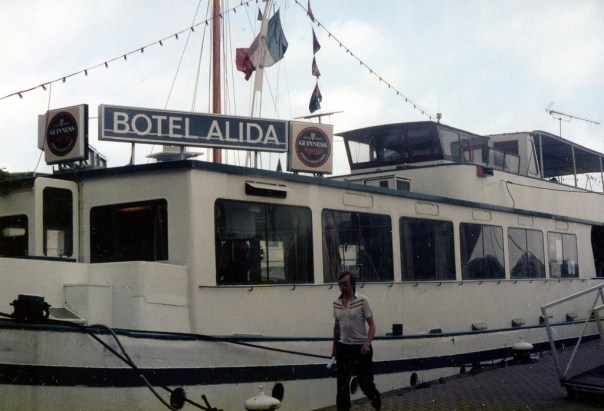
Jens and the Botel Alida

Dean and I married in June of 1985 and in July set off on a six-and-a-half-week tour of Europe. While it was all very memorable, one of the most memorable parts of the trip was our few days in the Netherlands. I was a little apprehensive about visiting Amsterdam, having heard tales of rampant drug use and general debauchery in and out of the red light district, but was young and curious as well.

We arrived in Amsterdam on the train and was immediately approached by a young Irishman asking us if we needed a place to stay. We were familiar with this tactic — having been approached in Ireland at the train station in Galway — and knew that, while it was not going to be a 5-star accommodation, it was bound to be an experience. We followed the young man a short distance to a houseboat, moored on the canal. This, we discovered, was called a “Botel”.

The Botel Alida
The Botel Alida

Our room was adequate, for a houseboat, but the shower (I don’t recall if it was a shared bathroom or not) was another story. The bottom of the shower contained ankle-deep water. Ankle-deep dirty water that sloshed around when the boat rocked. I remember thinking, at the time, that this would be a good story to tell when we were back in the States.

The Botel Alida, as the botel was called, was a bed and breakfast, so we met our fellow passengers at breakfast the next morning. One couple was about our age and we struck up a conversation with them. His name was Jens and he was from Sweden. He had finished college, I think, and was about to start military duty when he returned from his vacation. His companion was a woman from Austria. Jens spoke English, but his girlfriend did not. Dean and I didn’t speak anything other than English, so Jens spoke in English to us, Swedish to his girlfriend (I think) and translated for the three of us. We spent the day together, if I recall correctly, and then had dinner together. I believe we had a Rijsttafel, but Dean doesn’t remember it. I do remember the conversation at dinner though. Jens said that he’d noticed Dean and me at breakfast and was surprised that we were not like the other Americans on the botel. He said that he heard the others complaining about the accommodations and breakfast offerings. They didn’t like their rooms or the smell of the canal. They didn’t like their breakfast. He said we were not typical “Ugly Americans”. I still bask in the warmth of that compliment, these 25 years later.

After dinner we went to a coffee shop (which was called The Hard Rock Cafe, but not the one that is there now) and saw, with our own eyes, hashish listed on the menu. None of us ordered any. Dean was about to begin a new job and was concerned that if he did try something it might show up in any blood test he may have to take. The same went for Jens, except he was going into the Military directly after his vacation. Jens’ girlfriend wanted “space cake” (the one English phrase she spoke), but the coffee house was out of it. I think we had coffee and perhaps dessert.

After the coffee shop we went back to the botel. There was a private party going on inside, so we all went to the deck and continued our conversation long into the night.

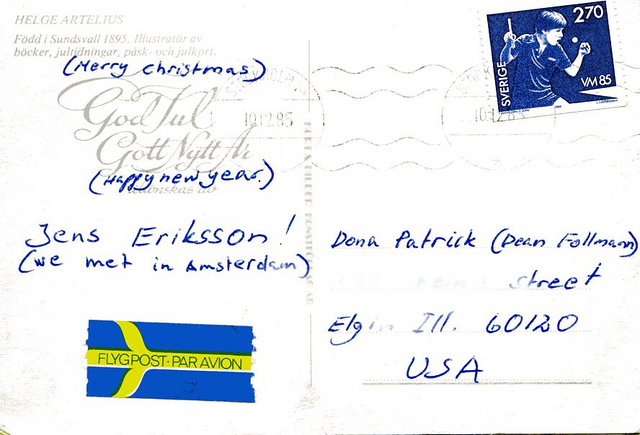
When we left Amsterdam we exchanged addresses with Jens and hoped to keep in touch. We sent a Christmas card to his address, but it was returned to us — he was not at that address anymore. He sent us a Christmas card which I’ve kept all these years. I came across it the other day, while organizing my office and  sincerely hope, that if we met again*, he’d still think we were not “Ugly Americans”.

*in case you are wondering, yes I did look him up on Facebook. Do you know how many Jens Erikssons there are on Facebook? About 150. I did send a message to one that seemed the right age. Although we have no photos of Jens and his Austrian friend, I can sort of recall what he looked like. I’ll keep you posted on any further correspondence. Or if I get banned from Facebook for stalking. (this would be a good time to be friends with Lisbeth Salander)

Outcast lunch table

Going from elementary school to junior high, I only had a handful of friends and none of them had the same lunch period as I did. I remember timidly walking into the cafeteria looking for a place to sit and eat the lunch I’d brought from home. I saw familiar faces, but no one I knew well enough to eat lunch with, so I sat at an empty table near the middle of the cafeteria and took out my sandwich and began to eat.

Before too long other people came to my table and it quickly filled up. At first I was flattered. These were popular kids. And some of them were boys. However, no one talked to me. I tried to become as small as possible and concentrate on eating my sandwich. A friend of the group at the table stopped by and wanted to sit with them so they forcefully evicted me — literally pushing me out of my chair so their friend could sit in it.

I grabbed my lunch and looked for another table, trying hard not to cry. I found a table with two girls I remembered from elementary school who were a year ahead of me.  They also were girls that other kids considered beneath them. One was a mannish-looking girl who was the daughter of friends of my parents. Another was a girl who, in elementary school, often came to school dirty and smelly.  I hesitated asking if I could sit at this table, knowing that associating with these girls would secure my fate as an outcast; but I needed a place to sit so I asked if I could sit with them. They welcomed me warmly. As the lunch period went on, more girls joined us — each of them quirky in her own way.

I sat with these girls for the rest of the time I was in junior high; and one of the girls that joined  us that first day became my best friend for the next several years. I’m ashamed of my initial reaction to the girls at that table. In hindsight I know that one was going through an inner struggle, trying to figure out her sexual identity and the other was the child of alcoholic parents. I, who’d just been physically pushed out of a chair, had no business judging the worthiness of anyone else.

I like to think that I, and all the girls that sat at the outcast table, became the interesting adults while the kids that pushed me away from their table grew up to be boring.